
December’s reptile of the month is the Eastern Milk snake! The Eastern Milk snake
(Lampropeltis triangulum) is a harmless, nonvenomous snake native to much of the
eastern United States and parts of Canada. Although often mistaken for a dangerous
species due to its bold coloring and defensive behavior, the milk snake is actually
harmless. The name “milk snake” originates from an old myth that these snakes would
sneak into barns to suck milk from cows a claim that has no scientific basis. They are
primarily after rodents, which often congregate around barns and feed storage areas.
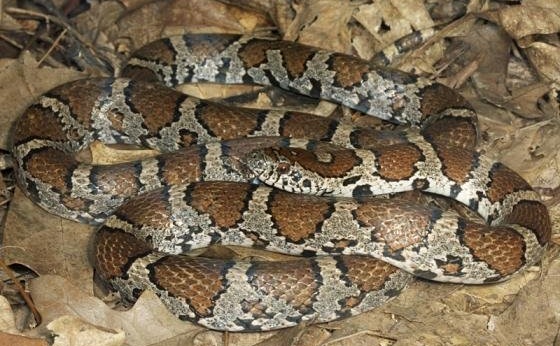
Eastern Milk snakes vary widely in appearance depending on location. Most adults are
between 24 and 36 inches long, though some can reach over four feet. They often have a
gray or tan background color with reddish-brown blotches bordered in black. In some
areas, they show more of a banded appearance, with red, black, and yellow or cream rings.
Many also have a Y- or V-shaped mark on the back of their head and a black and white
checkered belly. Juvenile milk snakes tend to have brighter, more vivid colors that dull
slightly with age. Eastern Milk snakes favor habitats such as rocky hillsides, forests,
meadows, and farmland. They’re often found hiding under rocks, logs, or boards, and
sometimes take shelter in human-made structures, such as barns, old foundations, and
basements.
Milksnakes are primarily nocturnal during warmer months, which helps them avoid
predators and high daytime temperatures. They are excellent at hiding and will spend most
of their time undercover. When threatened, they may vibrate their tails rapidly against dry
leaves or debris, a mimicry behavior that can sound like a rattlesnake’s warning.
Their diet is one of the most interesting aspects of their biology. Eastern Milk snakes feed
on a variety of prey, primarily rodents. They also eat other snakes, including venomous
ones, thanks to natural resistance to some snake venom. Additionally, they may consume
birds, eggs, amphibians, insects, and even carrion.
So, the next time you spot an Eastern Milk snake slipping between rocks or
sheltering near a barn, observe from a distance.